
The Last Chapter

Dear Subscribers and Fellow Bus Companions:
Today is a special day in the long bus trip we have been taking since May of 2024. At long last we have arrived at the final chapter in this gargantuan and monumental novel. To commemorate this event, Lori and I would like to ask each of you to compose a short comment reflecting what might be termed a “summative judgement” on the book and post it in the comment section. It need not be based on a complete reading of the book but it should reflect something of your adventures with the book’s immensity, complexity, difficulty, ambitions, and setting in the grand scheme of things, which includes you and your fundamental needs as a reader of what might be termed “essential literature.” Situate your comment in the context of what most readers expect of a last chapter in a book. Whatever it may contain, it must somehow be something of a valediction, a conclusion, a gathering of what has gone on since the beginning in a house of words worthy of those familiar and often horrifying words, “The End.”
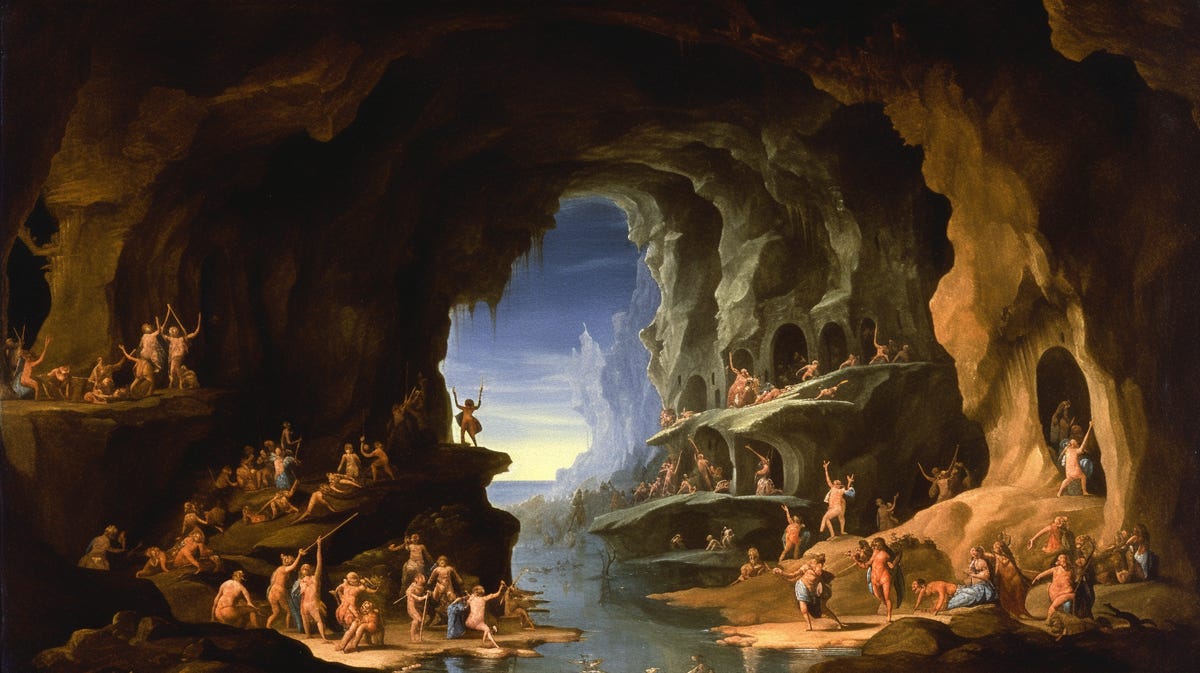
In this and the several posts to follow, Lori and I will attempt to “map” the terrain of this final chapter, in order to bring into the present moment the significance of this journey of memory, dreams, and visions that make up a play of shadows on the wall reminiscent not only of Plato’s and Prospero’s respective caves, but the intricate labyrinth of this theatre we call “Involutions of the Seashell.”
To no one’s surprise, the last chapter of this book is multi-faceted and layered. Though a mere 25 pages, it covers an enormous amount of literary territory. To my thinking, the map centers on the following elements: 1: Silence 2. Loss 3. Music 4. The Co-incidence of Opposites 5. Comedy 6. Death 7. Dreams. Deliberately and impossibly broad, these subjects are intended to do justice to what “goes on” in chapter 82 while nudging our reflections in the direction of what, in the final analysis, is important, not only in the book, but in the Book.
What follows is a severely abbreviated look at these seven elements. In the weeks to follow, right to the end, our reflections and yours of Chapter 82 will help broaden and enflesh these stick figures.
Silence. Not only physically as in the discussion of the world of the deaf (a central feature of our book, especially in the case of the Stone Deaf Man) but also cosmic, as in Pascal’s silence of those infinite spaces between the stars.
Loss. Miss Young said in an interview: “I would say my theme has always been paradise lost, always the lost cause the lost leader, the lost utopia.”
Music. This chapter, 82, self-titled “The Music of a Dying Universe,” alerts us not only to the music IN the book, but OF the book.
Co-incidence of Opposites. “My beginning was my end, and my end was my beginning.” (p. 1314, plagiarizing TS Eliot).
Comedy. As in the radical inclusivity of stage comedy where everyone in the play takes a collective bow. Here, the stillborn of Esther Longtree are seen beyond the stage, in the clouds, clapping their hands (p. 1321) And also in Dante’s sense of the word.
Death. The grandest illusion.
Dreams. Merrily, merrily, merrily.
Please post a thought, however brief, in the comment section — Michael Sexson
After reading it the first time there was one big question: why?! why Esther?! I cried at the "all our loves" last sentence and after re-readings I feel I have my answer. After reading the last sentence I thought this was the greatest book ever written but would have been hard pressed to answer why I thought so. I still can't tell you why the last line of the book hooked me although now I think it is the final reversal with Esther where she tells these stories and writes letters but she is illiterate. After all these years reading this book I now know this book is my reason for ever learning to read. My lifelong reading adventure has come to an end but it is also my beginning. 😅
I read MMMD twice in a row in 2024-2025, and then put aside thinking about it beyond following along with your thoughts. What you ask is a hard task. I feel like I read it in a kind of fever dream, and now I can only summon random impressions of my reading it: joy and frustration; wanting something, anything!, to happen, while simultaneously realizing that everything was happening; the sheer beauty and poetic construction of almost every damn sentence. It's a remarkable book that I will return to in a few years with love and trepidation.